1942 – Hope and Fear in the Shadow of Stalingrad
2nd April
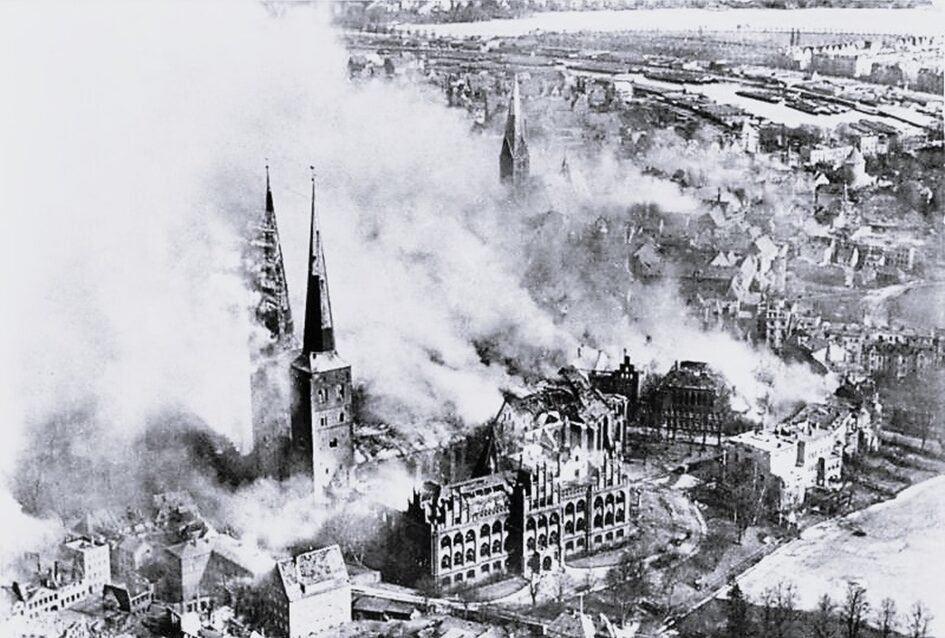
Air war comes to Germany
The air raids carried out by the anti‑Hitler coalition from 1939 to 1945 were a response to the military aggression of National Socialist Germany in Europe. Initially, the attacks by the Allies were conducted only tactically. After the German Luftwaffe — as it had already done during the Spanish Civil War, for example in the air raid on Guernica — began to fly strategic bombing missions against enemy cities such as Warsaw, Rotterdam, London, and other major British cities, the Allies from 1942 onward switched to a strategic use of their air forces with area bombings.
Based on the resolutions of the Casablanca Conference, a fundamental division of labor was established: nighttime attacks by the British Royal Air Force against area targets, and daytime attacks by the United States Army Air Forces against specific point targets. The Soviet air forces, by contrast, largely limited themselves to tactical objectives.
The air raids of the Western Allies aimed to destroy or weaken civilian infrastructure and war‑critical industry within the German Reich and, through attacks on city centers and residential districts, to demoralize the population.
The Royal Air Force’s air raid on Lübeck on March 29, 1942, was the first area bombing of a German city center by the RAF during World War II.
Hilde Nordhoff learned about the bombing on April 2, 1942, from a Chemnitz newspaper “and saw on the front page a picture of Lübeck, with St. Peter’s Church and other buildings. The city, the ‘Nuremberg of the North,’ as people write, has a few days ago fallen victim to a terrible air raid. The most magnificent churches have suffered great destruction. It must be dreadful to look at. Ah, what a terrible struggle, this air battle! And to think that not only thousands of people perish in it, but that the wonderful old buildings — those monuments that will never again greet us in their beauty — must be sacrificed; it is cruel. Too cruel! Not only this one city has such losses to mourn — hundreds of others as well!
I still have them all, the beautiful postcards you sent me last year from your stay in Lübeck. All the well‑known buildings are there, and when one thinks that today all that has become a desolate heap of rubble, one could be seized with powerless rage at what is happening. But — what can we do about it? The terrible judgment of this war is being carried out upon us, as upon the enemy, with merciless inevitability.”
11th November
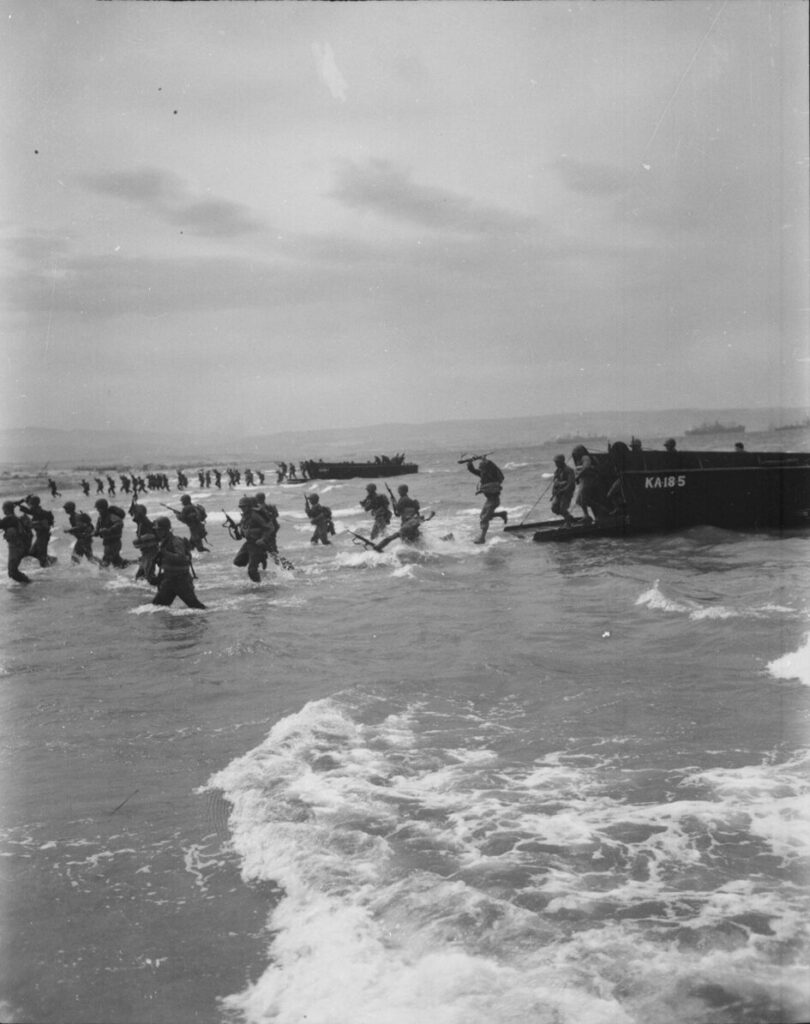
The beginning of the end of the African campaign
The North African campaign took place between September 1940 and May 1943 in North Africa. The war began in Egypt with the Italian invasion of Egypt in September 1940 but was pushed back into Italian Libya by the British counterattack by January 1941. After German Wehrmacht troops were deployed to Libya in February 1941, the Allies were again driven back to the eastern edge of Egypt. Because encircled Allied troops withstood the siege of Tobruk for months, British forces succeeded around the turn of the year 1941/42 in relieving Tobruk and pushing the Axis powers — in this case Germany and Italy — back into western Libya.
In January 1942, the Axis powers went on the offensive, drove the Allies back into Egypt, and captured Tobruk. In northwestern Egypt, British troops halted the Axis advance in the First Battle of El Alamein and the Battle of Alam Halfa between July and September 1942, then achieved a major victory in the Second Battle of El Alamein at the end of October 1942.
As the Axis powers withdrew from Egypt after this defeat, Western Allied troops landed in French North Africa in early November 1942, expanding the theater of war to Morocco, Algeria, and Tunisia. For the first time, units of the U.S. armed forces landed on the European-North African battlefield. The Axis powers, now pressured from two directions, retreated into French Tunisia and ultimately surrendered on May 13, 1943.
In his letter of November 11, 1942, Roland Nordhoff expressed concern about the further course of the war in view of the American intervention: “Revealing are the remarks of an American about the purpose of the American intervention in North Africa: (1) to strike Rommel, (2) to gain bases for assisting the Soviets, (3) to enable an attack on Italy. These are intentions and dangers that must be taken seriously. To be sure, the attackers have taken a great risk upon themselves: that they might be caught by the submarines. But those are not as fast as the mighty transporters and warships. Yes — the American is coming — his armaments industry is only now getting up to speed and will make itself felt even more strongly in the near future.
Victory has not become any easier with his entry into the war — and if the Japanese were not on our side, he would be a formidable opponent with his powerful fleet. What an enormous, blazing hatred it is that sets such a war machine in motion and keeps it going — grim, relentless hatred! If only good inspired people to such efforts and deeds as hatred does in war. What may God have decreed for our people? — And yet we can do nothing but hope for victory — because it is the only basis from which we might ever again reach a freer life.”