1943 – First cracks in the belief in victory
January/ February
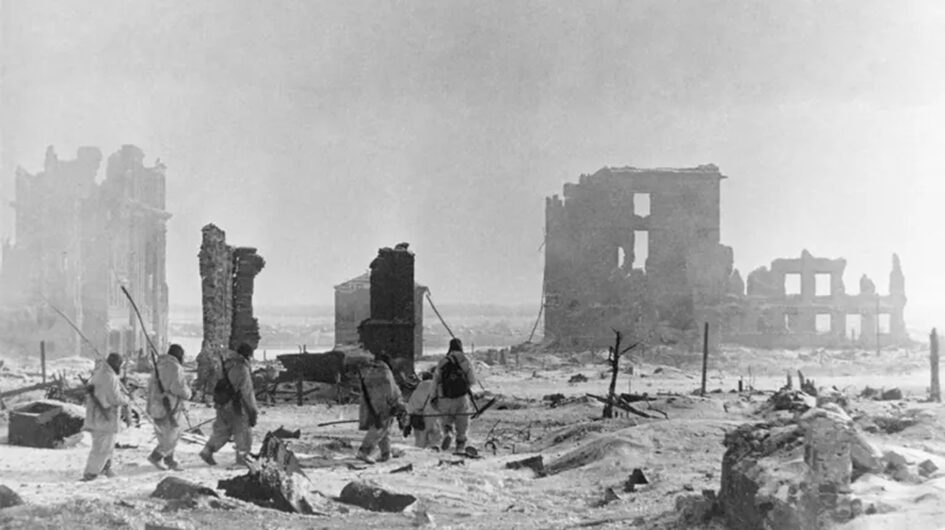
Battle of Stalingrad as a turning point
The Battle of Stalingrad is one of the most famous battles of the Second World War. The destruction of the German 6th Army and its allied troops in the winter of 1942–1943 is regarded as the psychological turning point of the war, after National Socialist Germany had invaded the Soviet Union in June 1941 despite a non‑aggression pact.
The industrial city of Stalingrad was originally an operational target of the German war effort and was intended to serve as the starting point for the actual advance into the Caucasus. After the German attack on the city in late summer 1942, up to 300,000 soldiers of the Wehrmacht and its allies were encircled by the Red Army following a Soviet counteroffensive in November. Adolf Hitler decided that the German troops should hold their positions and wait for a relief offensive, which, however, failed in December 1942 during Operation Winter Storm.
On January 22, 1943, Roland Nordhoff wrote, in view of the encircled German troops and their allies in Stalingrad, that “the news from the fronts is serious and foretells much, much suffering. You have certainly followed it: the stronghold of Velikiye Luki was abandoned — and Stalingrad is an island, no longer a front. Everywhere the enemy appears to be superior in numbers, and our war aims are set in such a way that we cannot shorten the front, that we may not retreat; victory is only ours if we hold on to everything we have gained. And to hold it, ever greater efforts are required — more and more men, more sacrifices — where is it all to lead? No one knows the answer. And ever more is demanded of you at home; ever more must be thrown into the maw of the monster that is war — how far can this still go?”
Although the situation of the inadequately supplied soldiers in the pocket was hopeless, Hitler and the military leadership insisted on continuing the costly fighting. Most soldiers ceased combat operations — partly on orders, partly due to lack of supplies and food — by late January or early February 1943 and went into captivity.
On February 3, the German High Command broadcast a special announcement on the radio stating that the 6th Army “had fought to the last breath under the exemplary leadership of Paulus” but had succumbed to “superior enemy forces” and “unfavorable circumstances.”
Claims by the Reich radio stations culminated in the assertion that all soldiers of the 6th Army had died. The announcement failed to mention that a total of 91,000 soldiers had gone into captivity — a fact already reported by the British radio station BBC — which led to more Germans seeking information from so‑called foreign “enemy stations.” As a result, Propaganda Minister Joseph Goebbels, who had orchestrated the announcement, was publicly exposed as a liar.
The magnitude of the German defeat in the Battle of Stalingrad was described by Hilde Nordhoff in a letter dated February 3, 1943, in which she wrote that “on this very day, the greatest heartbreak that we Germans have yet suffered in this war has taken place. The battle for Stalingrad is over. The 6th Army no longer stands. All have been crushed by the enemy’s superiority. Beloved one! What can words do here? It is beyond comprehension — it is to me beyond comprehension — that so much blossoming life will never return home. A dreadful judgment!”
Around 10,000 scattered soldiers who had hidden in cellars and the sewers continued their resistance until early March 1943. Of the roughly 110,000 soldiers of the Wehrmacht and allied forces who were taken prisoner, only 5,000 to 6,000 returned home. Over the course of the fighting for the city, more than 700,000 people were killed, most of them soldiers of the Red Army.